The work, in the order it ran
1. Read the license before the budget. Known: Shelby had a building, a date and a management team that needed the move to be somebody else's problem. Unknown: whether Tellus could hold the seat at all. Nevada requires a state contractor's license to contract for the work, and we did not have one. The license closed our path to the general contractor's seat. It did not close the job, and it did not close the general contractor option for Shelby, which is a distinction the whole decision turns on. What it changed: the first move was not a bid. It was a comparison of structures.
2. Lay the three structures side by side by who holds what. I wrote out, for each structure, who held the price if the trades ran over, who held warranty and default trade by trade, who bought out the trades and ran the day-to-day, the schedule and the city, and whose license the work ran under. That is the cover figure. Written that way, the pass-through option fell out on its own, since it added a layer without moving any risk that mattered off the owner, and the real choice was between a general contractor and going without one.
3. Check the three conditions. Known trades, a build-out, a real clock. I checked each against this job rather than in the abstract, and I would have recommended the general contractor if any one of them had failed. The trades were the same firms we ran in California, or ones they vouched for. The building existed and the work was inside it. And the date had a public opening behind it. What it changed: the recommendation went to Shelby scoped to this job, with the conditions stated, not as a general opinion that contractors are overpriced.
4. Put the risk transfer to Shelby as a trade, not a pitch. I told them where the overrun exposure and the warranty recourse would sit under the structure I was recommending, and what they would get for carrying it. They accepted it. What it changed: the structure had an owner who had chosen it. When something went sideways later, and on every job something does, the conversation was about the fix, not about who had agreed to what.
5. Buy out the trades on the owner's paper, each on its own license. Each trade contracted directly with Shelby, on a scope and a schedule of values I wrote and ran from the owner's side. The license question answered itself at that point: every trade was licensed in Nevada for its own work, which is all the state requires of a trade contractor working for an owner. Tellus's contract with Shelby was for management, not construction. What it changed: buyout ran in the time it takes to call people you already know and agree a price, which is the single biggest reason the date held.
6. Run the sequence, the cost and the city directly. Every coordination call, every change, every schedule conflict and every conversation with the building department ran through me. There was no contractor's layer to absorb friction or to take the blame, which is harder day to day and simpler when something needs deciding, because the person deciding is the person who will live with it. The facility opened on the date.
The trick was never removing the contractor. It was knowing exactly which of his risks we were taking on, and who was holding each one.
Open on the date, and what the saving was measured against
The strip below places the Las Vegas window inside the Shelby relationship. The relocation ran five months, October 2014 to March 2015, in the middle of the California work, and the facility opened on schedule. Tellus published the result the following year in its own release, which is where the saving on the cover comes from.
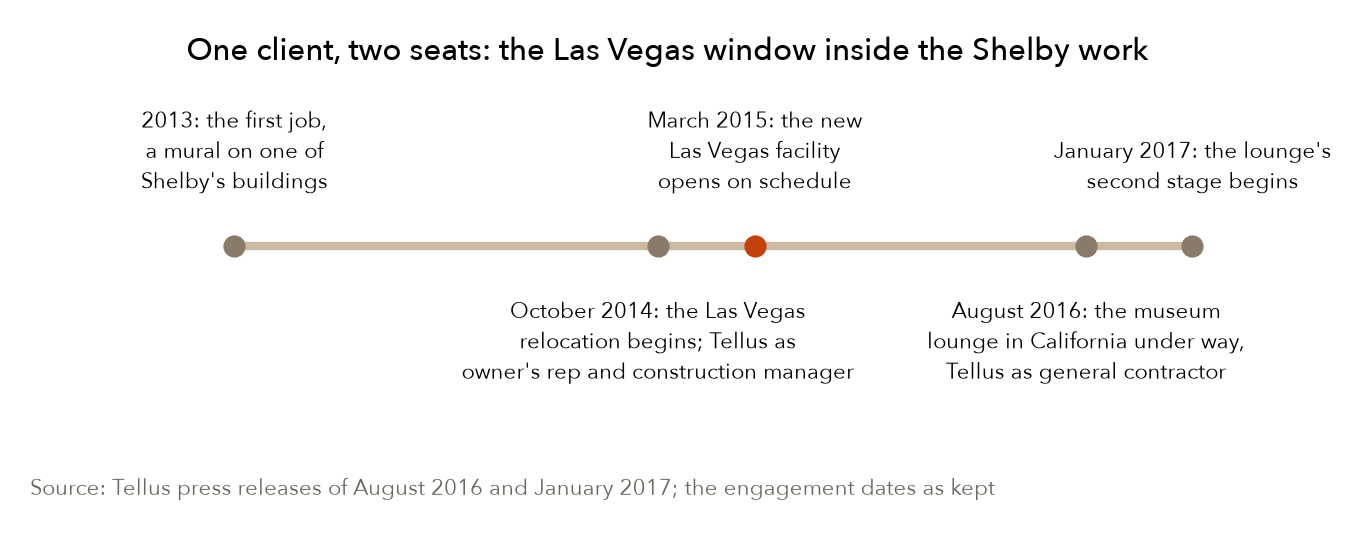
The saving is measured against the general contractor path, which is the right comparison and the one a buyer should ask about. What comes off the cost when the contractor comes off the job is his fee, and the part of his general conditions that our coordination replaced. What does not come off is the rest of general conditions, the dumpster, the temporary power, the site supervision, the final clean, because that work still has to be done and somebody still pays for it, and what goes back on is the fee Shelby paid Tellus to run the job. The net of those is the owner's saving. Attachment A sets that bridge out as a should-cost model a buyer could run on any relocation, and names the two inputs it needs that this report does not carry, so the figure on the cover is checkable rather than merely asserted.
What we kept, what we replaced, what we installed
Kept. The trades from the California work, which were the reason the structure was available at all. Shelby's opening date, which we treated as fixed from the first conversation because it was. And the general contractor's coordination, the sequencing, the schedule of values, the change control, all of which I had been doing for Shelby in California in a different seat.
Replaced. The general contractor's layer itself. That layer exists for a reason, and the reason is sound on most jobs: one bond, one warranty backstop, one price and one phone number, and an owner who never has to learn what a schedule of values is. It was put there by owners who had been burned by trades they could not manage, and it is worth every point it costs when the owner does not know the trades and the date can slide. Here the logic was faulty on both counts. The coordination it would have charged for was coordination we already had, and its onboarding would have spent the one thing the job could not spare, which was days. It had to change now, not on the next job, because the license had already taken the version of the general contractor Shelby actually wanted, which was us.
Installed. Owner-held trade contracts with a schedule of values run from the owner's side, which is a cost control that outlives the job because the owner ends up holding its own numbers. And the test below, which is the one I would use on any job where an owner asks whether they need a general contractor.
The three-condition test for going without a general contractor
Recommend owner-held multi-prime only when all three hold. First, the trades are known: we have run them before, or people we have run vouch for them, on this kind of work. Second, the scope is a build-out, not new structure; the failure modes are in sequence and coordination, which a construction manager can catch, rather than in the ground or the frame, which a price guarantee exists to absorb. Third, the clock is real: a date that cannot move, so a contractor's onboarding is a schedule cost and not merely a fee. If any one fails, hire the contractor, and say why.
What it cost to hold the line, and what I would watch
It cost Shelby the contractor's two guarantees, price and recourse, for the run of the job, and it cost Tellus a job run with no cushion, because an agency construction manager who guarantees nothing has nothing to hide behind either. Every overrun would have been visible and mine to explain, in real time, to an owner who had taken the exposure on my recommendation. The structure also ran on one person's bandwidth. Owner-held multi-prime has a ceiling, which is the number of trade interfaces one manager can hold at once before missed handoffs cost more than the contractor's layer would have, and a relocation of this size sat under it. A larger job, or two at once, would not have.
Three things I would watch on any job run this way. The first is the fee. A construction manager who takes a general contractor's percentage while shedding a general contractor's obligations has moved risk to the owner without moving the price, and the owner's saving is a transfer dressed as a reduction. The fee has to be set for the risk the manager actually holds. The second is the trade count, for the ceiling above. The third is the license itself, which is a design constraint and not a wall. It closes one seat. Read early, it tells you which structures are still open and what each one costs the owner, and that reading is worth doing before anyone prices anything.
The license was the wall. The clock was the cost. Everything else was knowing which risk moved, and to whom.
What it produced
The facility opened on schedule in March 2015, five months after the relocation began, on trades Shelby contracted directly and Tellus bought out, sequenced and ran as owner's representative and construction manager. Tellus's own press release the following year put the saving against the general contractor path at upwards of $300,000, measured against what a general contractor's fee and onboarding would have cost, not as money that changed hands.
A slice of the project list
A few related projects.
- Santa Monica House: sorted licensed and skill-bound scope when the crews stopped coming, as Chief Executive Officer of Tellus (2020).
- Contractor Gorilla: the search strategy that put Tellus Design and Build on page one of Google for design build Los Angeles (2014 to 2017).
- Greensburg, Kansas: preconstruction and general contracting lead coordinating the town's green rebuild (2007 to 2008).
- Habitat for Humanity: construction partner through Tellus across three Southern California chapters (2007 to 2016).